Meta AI image provenance
Meta Content Seal watermark checker
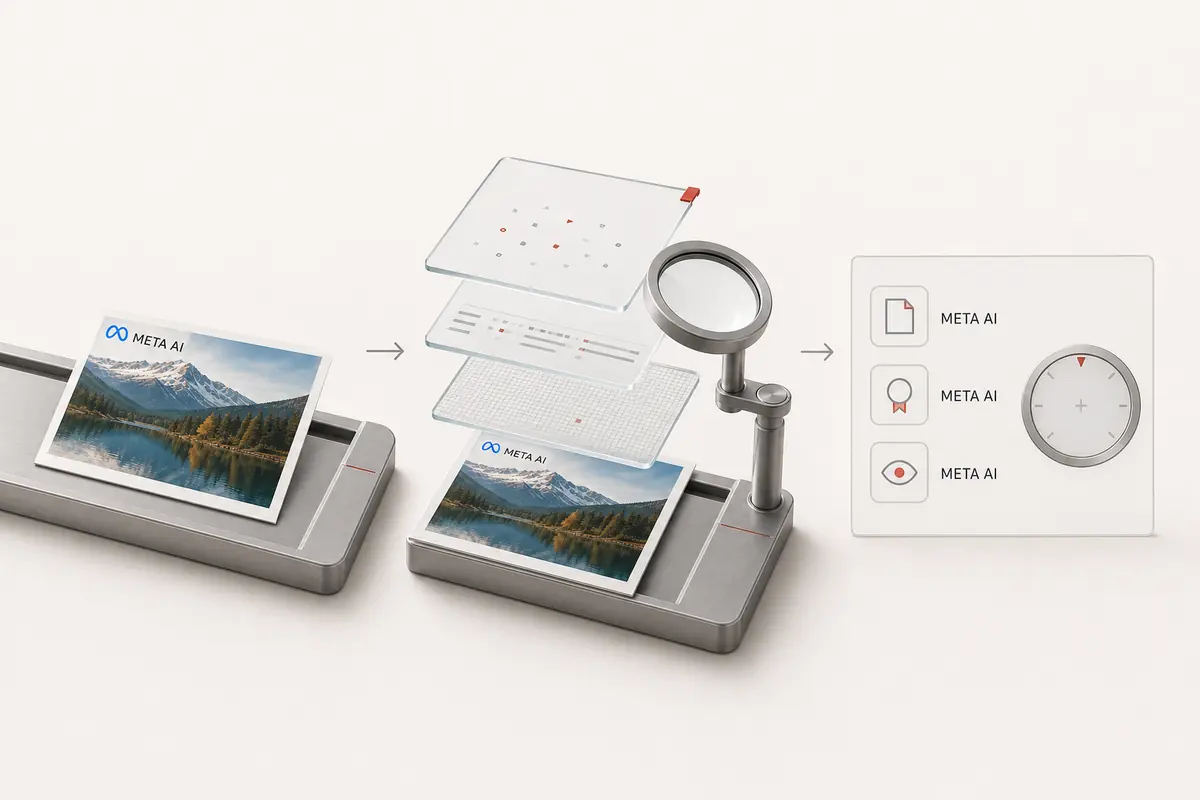
Inspect Meta AI and Muse Image files for C2PA credentials, IPTC AI-source declarations, and generator metadata. Review the distinct scope of production Content Seal and Meta’s public research models.
- IPTC AI-source declarations
- C2PA validation and trust
- Content Seal research context
- Checking service
- Choose file
- Inspect content
- View report
Step 1 of 4: Checking service.
Service check
Preparing the provenance inspector
Confirming the inspection service is ready before anything is sent.
Distinguish Meta file evidence from Content Seal
Meta’s Content Seal repository describes a proprietary Muse Image implementation alongside downloadable research models. This workflow inspects file records; it does not substitute an open research-model detector for the production watermark.
AI-source declarations
Read an IPTC digital source type when present. It is a declared source, not proof that Meta generated the image.
Signed credentials
Evaluate returned actions and provider claims together with credential integrity and signer trust.
Research-model boundaries
AudioSeal, VideoSeal, PixelSeal, and Watermark Anything inspect compatible model marks, not all production Meta AI watermarks.
Platform labels
Instagram and Facebook may use additional information. A file report cannot predict the label a platform will apply.
Understand results across different files
Compare the original export with the copy you received. These examples explain possible outcomes; your report reflects only the checks completed on your submitted file.
- Original Meta image export with credentials
- Parsed credential with validation and trust states
Inspect recorded actions and the signer. Only valid, trusted provenance can support stronger attribution; a manifest's presence alone is insufficient.
- Credential with a broken signature or content binding
- Invalid credential
The file failed the reported integrity check. Do not treat its claimed generator or issuer as verified authorship.
- Unsigned software tag naming Meta
- Declared source only
A software name can be edited or copied. It is a useful lead, not a verified provider watermark.
- Screenshot, re-encoded, or stripped copy
- No credential found, or reduced evidence
This copy may have lost its file records. Missing metadata does not establish human origin or absence of an embedded watermark.
- Muse Image Content Seal or a public research-model mark
- Separate detector required
Meta's production implementation and public AudioSeal, VideoSeal, PixelSeal, or Watermark Anything models are not interchangeable.
How to check your content
Choose a Meta image export
Upload a JPEG, PNG, or WebP up to 10 MB. Use the original export when available.
Read declared and signed evidence
Compare IPTC AI-source declarations and generator fields with any C2PA validation and signer-trust result.
Check Content Seal scope
Treat production Muse Image verification as a separate provider check. Public research-model marks are not interchangeable with that production signal.
Evidence you can use
Every report separates cryptographic credentials, declared metadata, and provider-controlled verification. You can see exactly what ran before deciding what the file proves.
- C2PA Content Credentials parsing and cryptographic validation for supported files.
- Declared EXIF, XMP, IPTC, container, and generator metadata evidence.
- A precise boundary and official path for provider-controlled verification when one exists.
Frequently asked questions
What can this Meta Content Seal checker inspect now?
It reads supported C2PA records, IPTC digital-source declarations, and generator metadata from JPEG, PNG, and WebP files. The report states which evidence exists and which provider-controlled checks did not run.
Can public Meta research models decode Muse Image Content Seal?
Meta says Muse Image uses a custom proprietary implementation. Public PixelSeal, VideoSeal, AudioSeal, and Watermark Anything models are separate research releases; their results do not establish production Meta AI origin.
What can AudioSeal or VideoSeal legitimately detect?
A compatible decoder can test marks from its corresponding released watermarking model. Because others can apply those models too, a decoded mark does not by itself identify Meta as the content creator.
What does trainedAlgorithmicMedia mean in a Meta image?
It is an IPTC declaration that generative AI was used. It may help review a file, but an unsigned or editable declaration does not prove who generated it.
Will this predict the AI label on Instagram or Facebook?
No. Platform labels can depend on information beyond the uploaded file and can change by product. This report describes surviving file evidence, not a future moderation or labeling decision.