Claude AI Watermark 2026: Invisible Text Watermarks, C2PA Files, and the EU AI Act
Claude now marks supported output in two different ways: an imperceptible text watermark and signed C2PA provenance on supported files. Here is what each signal can—and cannot—prove.
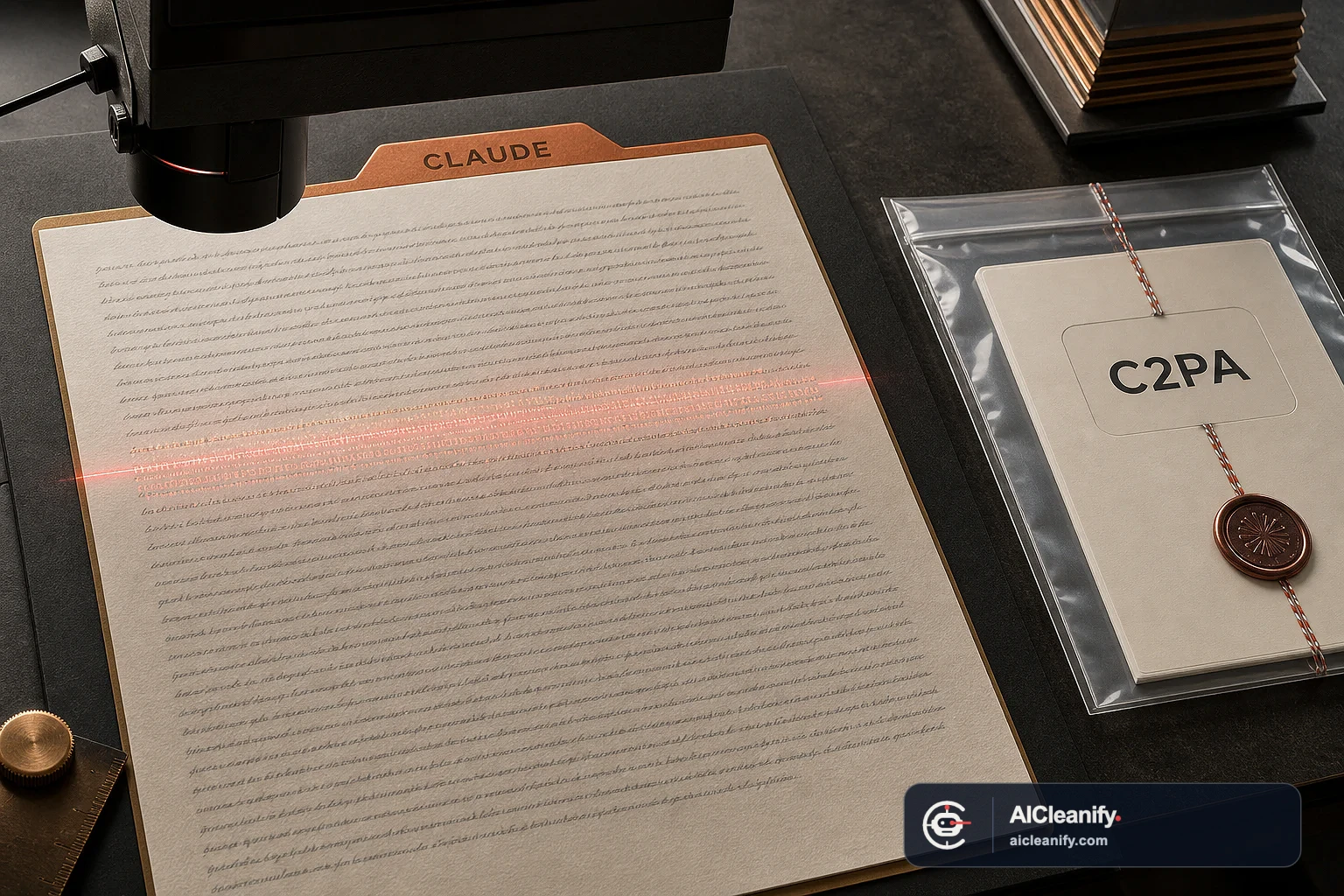
Key takeaways
- As of August 24, 2026, Anthropic documents embedded text watermarks for supported Claude models and signed C2PA provenance for supported file outputs.
- Anthropic has not published the third-party text-watermark detection mechanism yet, so there is no public provider verifier that can conclusively check the official text mark today.
- A detected Claude mark indicates that content may have been processed by Claude; it does not prove Claude originated every word, idea, or data point.
- Zero-width or unusual Unicode characters are inspectable text data, but Anthropic does not identify them as its official watermark and they cannot prove Claude authorship.
- A missing watermark or C2PA manifest is not evidence of human authorship because older models, short or heavily edited text, unsupported platforms, and file transformations can remove or prevent signals.
Yes—Claude now has a watermark policy, but “the Claude watermark” is not one universal stamp. As of August 24, 2026, Anthropic says supported Claude models embed an imperceptible mark in generated text and attach signed C2PA provenance metadata to supported file outputs such as SVG, PNG, and JPG. These are different technologies with different verification paths. The text mark travels with copied wording and may survive some edits; the file credential travels as signed metadata and can disappear when a file is re-saved, converted, or screenshotted.
The most important limitation is equally direct: Anthropic has not yet published a public detection mechanism for its official text watermark. Its help center says user and third-party detection support is coming in forthcoming technical documentation. Until that appears, a site can inspect ordinary Unicode characters or a file’s C2PA manifest, but it cannot honestly claim to verify Anthropic’s undisclosed model-level text mark. A detected mark, once supported, would indicate that material may have been processed by Claude; it would not prove that Claude originated every word or idea.
This guide separates confirmed facts from inference, explains what a Claude AI watermark checker can check today, and gives publishers a defensible workflow for text and files. It is based on Anthropic’s current help article, the European Commission’s Article 50 guidance, the EU Code of Practice, and the C2PA specification. Because the rollout and detector documentation are still changing, every coverage statement below is date-stamped.
What Anthropic actually announced in August 2026
Anthropic’s current help-center page says it signed the EU AI Act’s Article 50(2) Code of Practice on Transparency of AI-Generated Content as a provider of generative AI models and systems. It describes a marking program for Claude models launched in the EU on or after August 2, 2026. Those models support machine-readable marking at launch, while Anthropic says it is working to extend support to models released before that date.
The scope is broader than the consumer chat website. Anthropic says markings from supported models apply across Claude Platform (API), Claude, Claude Code, Claude Cowork, Claude Tag, and supported access through AWS, Google Cloud, and Microsoft Foundry. It also says the marking applies wherever Claude is offered, worldwide—not only to sessions located in the European Union. There is an important platform qualifier: some features may not support every marking type, and signed file provenance may vary with the capabilities offered by a cloud partner.
The two confirmed marking layers
For text, Anthropic describes an imperceptible watermark woven directly into generated text at the model level. The company says it does not change the response’s meaning, quality, or readability; it travels when text is copied and pasted; and it may persist through some editing. Anthropic has not publicly described the encoding algorithm. Calling it statistical, token-based, Unicode-based, or cryptographic would go beyond what the provider has confirmed.
For supported files, Anthropic says Claude attaches digitally signed provenance metadata following the C2PA open standard. The named examples are SVG, PNG, and JPG. This credential can record that the file was processed by Claude and can make later tampering detectable when the credential, signature, and asset binding validate. It is provenance data attached to a file, not the same mark used in prose.
What remains unavailable
Anthropic promises to help users and third parties detect Claude’s marks, but, as of August 24, its help page still says it will share detection mechanisms in forthcoming technical documentation. There is no linked public Anthropic text-verification page, downloadable detector, or documented API that a third-party Claude AI watermark checker can use. That absence matters: without the provider’s detection method, a checker cannot convert a writing style, a few Unicode code points, or a generic AI-classifier score into an official Claude-watermark verdict.
Claude text watermark, C2PA, Unicode, and classifiers are not interchangeable
Search results often collapse several signals into one “AI watermark.” A useful verification report keeps them separate because each answers a different question.
| Signal | Where it lives | What it can support | What it cannot prove |
|---|---|---|---|
| Claude embedded text watermark | In generated text at the model level, according to Anthropic | With Anthropic-compatible detection, that text may have been processed by a supported Claude model | Original authorship, ownership of ideas, unchanged text, or complete provenance |
| Claude C2PA provenance | Signed metadata attached to a supported file | Manifest validity, content binding, declared processing history, and signer trust when the validator recognizes the signer | That every pixel or idea was created by Claude, or that the represented claim is factually true |
| Zero-width or unusual Unicode | Literal code points in pasted text | Which characters exist, where they occur, and whether removing them changes the string | Claude authorship or detection of Anthropic’s undisclosed official mark |
| Generic AI-text classifier | A model’s probability or label based on writing patterns | A heuristic risk signal under the classifier’s own tested conditions | A provider watermark, a cryptographic identity, or a reliable verdict for every language and genre |
This distinction prevents two common errors. First, “I found a zero-width character” does not mean “Claude wrote this.” Hidden characters can come from word processors, accessibility systems, web editors, copy-and-paste pipelines, and deliberate formatting. Second, “the C2PA signature validates” does not mean “the file is true.” It means the credential and bound asset passed defined technical checks; interpretation still depends on the assertions, signer trust, and the use case.
How the invisible AI text watermark should be interpreted
Anthropic’s wording is deliberately narrower than many headlines. It says the watermark is imperceptible, part of the text, applied at the model level, and capable of surviving copying and some editing. It does not disclose how the signal is encoded, how much text is needed, detection thresholds, false-positive rates, supported languages, or robustness measurements. Those unanswered questions make independent performance claims premature.
A positive result would mean processing, not authorship
Claude is frequently used to proofread, translate, summarize, format, or transform material that originated with a person or another system. Anthropic explicitly warns that a detected mark would not be fully conclusive and may be present when the underlying ideas, text, or data came from elsewhere. A human-written paragraph lightly transformed by a supported model could carry a mark; so could a translation of a human interview. “Processed by Claude” is therefore the accurate interpretation, not “authored by Claude.”
The content can also change after Claude processes it. A marked passage may be excerpted, combined with other writing, reordered, or edited by multiple people. A detector result would describe a surviving signal in the submitted sample, not reconstruct the entire editorial history.
A negative result would not prove human origin
Anthropic lists several reasons Claude-processed text might not carry a detectable mark: it may come from an older model; it may have been heavily edited, paraphrased, translated, or mixed with other writing; or it may be too short for a reliable signal. A platform, product, feature, or output type may also lack support. These limitations create an asymmetric result: presence can be relevant evidence, while absence is not a human-authorship certificate.
This is why claims such as “100% undetectable,” “guaranteed human,” or “official Claude detector” deserve skepticism unless the vendor documents the exact compatible signal, validation method, decision thresholds, and error rates. As of the date of this guide, Anthropic has not made those detector details public.
How Claude C2PA metadata works on supported files
C2PA Content Credentials are tamper-evident provenance records. A manifest can contain assertions about how an asset was created or edited, a content binding that connects the manifest to the asset, and a digital signature. Validation is a multi-step process: a tool parses the manifest, checks its structure and assertions, validates the signature, tests the asset binding, and evaluates the signing credential against a trust list.
That last step is easy to overlook. The C2PA specification distinguishes a well-formed manifest, a valid manifest, and a trusted manifest. A technically valid signature is not automatically trusted by every validator. A trusted result requires a valid manifest and a signing credential that chains to an accepted trust anchor. A responsible viewer should report signature validity and signer trust separately rather than compressing them into one green badge.
What to expect from a supported Claude file
Anthropic names SVG, PNG, and JPG as examples of supported output. When the signed label is present, the provider says it signals that the file was processed by Claude and allows tampering to be detected. In practice, inspect the active manifest, claim generator or issuer information, declared actions, signature status, asset-binding status, and trust result. Save the raw report with the file if the decision may later need to be audited.
The closest copy to Claude’s original export provides the strongest evidence. Email clients, content-management systems, optimization services, and social platforms may change or discard metadata. Re-saving an image, converting it to another format, or taking a screenshot can separate the pixels from the original manifest. C2PA supports durable-credential techniques, but Anthropic’s announcement specifically describes signed file metadata; it does not promise that every stripped Claude credential can be recovered from every transformed copy.
What a C2PA result does not say
A Content Credential records provenance claims; it is not a fact-checker. A valid and trusted Claude-related credential can support that a recognized system signed a claim about processing and that the bound asset has not changed outside the declared history. It does not certify that the scene depicted is real, that a chart’s numbers are correct, or that Claude originated the underlying source material. Conversely, no manifest means only that no supported credential was found in that copy.
For original or least-processed image files, AICleanify’s C2PA Content Credentials viewer separates manifest validity, signer trust, issuer or generator fields, and available action history. Use the result as one evidence layer, and retain the original asset for any high-stakes review.
Can Unicode reveal the Claude watermark?
No public evidence from Anthropic says its official text watermark is a set of zero-width characters. The provider calls it an embedded, model-level watermark and withholds the technical encoding pending later documentation. It may ultimately be detectable through statistics, token choices, an encoding scheme, or another method, but selecting one of those mechanisms today would be inference—not confirmed fact.
A Unicode scan still has a legitimate purpose. It can enumerate characters such as zero-width spaces, directional controls, variation selectors, non-breaking spaces, and confusable letters. It can show exact code points and positions and help diagnose text copied from an editor. But it should label the result “hidden or unusual Unicode found,” not “Claude watermark detected.” It also should not silently remove characters with semantic, linguistic, or accessibility functions.
The AI Watermark Checker can inventory literal Unicode in pasted text and file-level metadata in supported uploads, while the Claude watermark status page tracks Anthropic’s official detection availability. The Claude-specific check remains unavailable until a dependable provider-compatible method exists. That limitation is more useful than a fabricated verdict.
A practical Claude watermark verification workflow
Use the following process when a publishing, compliance, education, or incident-response decision depends on Claude provenance. The workflow deliberately records both what was tested and what remained unavailable.
Preserve the best available evidence
For a file, keep the original download and work on a copy. Record its filename, size, cryptographic hash, acquisition time, source URL or system, and any transformations already performed. For text, preserve the longest available continuous passage, its formatting, and the application it came from. Do not normalize whitespace or pass it through a rewriting tool before the first check.
Identify which marking layer could exist
Plain text calls for Anthropic-compatible text-watermark detection, which is not publicly documented yet. SVG, PNG, and JPG files may carry Claude C2PA provenance if generated through a supported model, product, and platform. Other formats may still contain ordinary metadata, but they are not confirmed by Anthropic’s announcement as examples of signed Claude output. If the material came from a model released before August 2, coverage may still be in progress.
Inspect literal text without attributing it
Run a Unicode inventory and save the code points, counts, and positions. Treat that output as a formatting report only. If an official Claude detector becomes available later, run it on the preserved original passage and record the detector version, date, minimum-length guidance, and full response. Do not substitute a generic AI-writing score for the provider mark.
Validate file credentials in layers
Parse the C2PA manifest, then record: manifest presence; signature validity; signer trust; claim generator or issuer; content-binding result; declared actions; and validation warnings. If the credential is absent, repeat the check on the closest original export. If the credential is invalid, distinguish a damaged binding from an untrusted signer or malformed manifest. Those conditions have different meanings.
Write a conclusion that matches the evidence
Use bounded language. Good conclusions include “a trusted C2PA credential says this file was processed by Claude,” “unusual Unicode was present but is not Claude attribution,” or “no supported mark was found in this copy.” Avoid “Claude definitely wrote it” and “definitely human.” Include the date because provider coverage, trust lists, and detector availability can change.
Why the EU AI Act matters—and what it does not automatically require
Article 50(2) of the EU AI Act requires providers of systems generating synthetic audio, image, video, or text to ensure outputs are marked in a machine-readable format and detectable as artificially generated or manipulated. The techniques must be effective, interoperable, robust, and reliable as far as technically feasible, considering modality, limitations, cost, and the state of the art. The Commission says these transparency obligations began applying on August 2, 2026.
The Code of Practice is a voluntary route for demonstrating compliance; the underlying Article 50 duties are legal obligations. The Commission’s current FAQ says systems placed on the market before August 2 receive a limited transition for the provider marking-and-detection obligation until December 2, 2026. Anthropic likewise says support for its earlier models is in progress.
Provider marking and publisher disclosure are different duties
Provider marking is the machine-readable layer Anthropic is implementing. Deployer disclosure under Article 50(4) concerns, among other cases, AI-generated or manipulated text published to inform the public on matters of public interest. The Commission’s guidance says substantively human-reviewed text under editorial control and responsibility can fall outside that labelling duty. Superficial grammar or formatting checks alone do not amount to substantive human review.
The Act and Commission guidance also describe exceptions and scope limits, including standard assistive editing that does not substantially alter input or meaning. A watermark result is therefore not itself a complete legal analysis. The relevant questions include which model and system were used, what transformation occurred, whether the output falls within scope, how the text was reviewed, who holds editorial responsibility, and where the system and output are used. Organizations should document that process and obtain qualified legal advice for compliance decisions.
What publishers, developers, and auditors should do now
Publishers should add provenance capture to the beginning of the editorial workflow rather than trying to reconstruct it at publication time. Keep source drafts, record AI-assisted transformations, preserve original files, and assign a human reviewer with authority to change or reject substantive claims. A final disclosure policy should be based on use and applicable law, not on whether an invisible mark happened to survive.
Developers using Claude through the API or a cloud partner should not assume Anthropic’s implementation resolves every downstream obligation. Confirm which model and surface support which mark, avoid stripping supported provenance unintentionally, and monitor Anthropic’s forthcoming detection documentation. If you transform output into another format, document whether the process preserves C2PA and how users can access any associated credentials.
Auditors should preserve negative results as carefully as positive ones. Record the tool version, trust-list version, sample length, file hash, and checks completed. A negative report without coverage information is nearly meaningless. Where stakes are high, corroborate technical signals with source records, account logs, revision history, interviews, and editorial documentation.
Primary sources and dated reporting
- Anthropic Help Center, current as reviewed August 24, 2026: How Claude marks AI-generated content. This is the controlling source for announced model coverage, products, the two marking methods, promised detection support, and limitations.
- European Commission, updated July 31, 2026: Code of Practice on Transparency of AI-generated Content. This explains the code’s status, scope, and relationship to Article 50.
- European Commission, updated July 24, 2026: Transparency obligations under Article 50. This covers provider marking, deployer disclosure, exceptions, human review, and the transition for existing systems.
- Official EU legal text: Article 50 of Regulation (EU) 2024/1689. This is the primary text for the machine-readable marking requirement.
- C2PA specification, version 2.4: Content Credentials technical specification and the C2PA FAQ. These define validation, trust, tamper evidence, and the limits of file-bound provenance.
- Context, August 11–13, 2026: reporting from TechCrunch and Nature records the public reaction and open questions. These reports provide context; technical claims in this guide defer to Anthropic, the EU, and C2PA.
The bottom line
The August 2026 Claude watermark news is real, but the accurate story is narrower than many “AI detector” headlines. Supported Claude models now have a model-level text marking commitment, and supported file outputs can carry signed C2PA provenance. Neither signal proves complete authorship. Absence proves even less.
Today, the strongest workflow is to preserve originals, inspect file credentials, inventory literal text data without attributing it, and wait for Anthropic’s documented text-detection mechanism before claiming an official Claude result. That approach gives publishers and reviewers something more valuable than a confident guess: a dated, reproducible record of exactly what the available evidence supports.
Frequently asked questions
Does Claude watermark AI-generated text in 2026?
Yes, for supported models. Anthropic says Claude models launched in the EU on or after August 2, 2026 support machine-readable marking at launch, with an imperceptible watermark embedded in generated text. Anthropic is also working to add marking to older models.
Is there a public Claude AI watermark checker?
Not for the official embedded text watermark as of August 24, 2026. Anthropic says it will support user and third-party detection, but its technical detection documentation is still forthcoming. C2PA viewers can separately inspect supported Claude-generated files.
Is the Claude watermark made of zero-width Unicode characters?
Anthropic does not say that. It describes an imperceptible watermark applied at the model level and has not published the encoding method. A Unicode inspector can find literal hidden characters, but those characters do not establish Claude authorship.
What is Claude C2PA metadata?
It is digitally signed provenance metadata attached to supported Claude-generated files such as SVG, PNG, and JPG. A validator can inspect the manifest, signature, signer trust, and content binding. The result indicates processing history, not the truth of the file’s content.
Can editing remove a Claude watermark?
It can make a mark unavailable or undetectable. Anthropic lists heavy editing, paraphrasing, translation, mixing with other text, very short passages, unsupported surfaces, format conversion, re-saving, and screenshots among the reasons a mark may not be detected.
Does the EU AI Act require every Claude-assisted article to carry a visible label?
No. Article 50 separates provider machine-readable marking from deployer disclosure duties and includes scoped exceptions, including standard editing and substantively human-reviewed public-interest text. The exact duty depends on the system, output, use, and editorial process; obtain legal advice for a compliance decision.