YouTube AI Content Labels 2026: C2PA, SynthID, Monetization, and Creator SEO
A source-backed creator guide to YouTube’s 2026 AI disclosure flow, automatic labels, C2PA and SynthID signals, monetization policy, and practical video SEO.
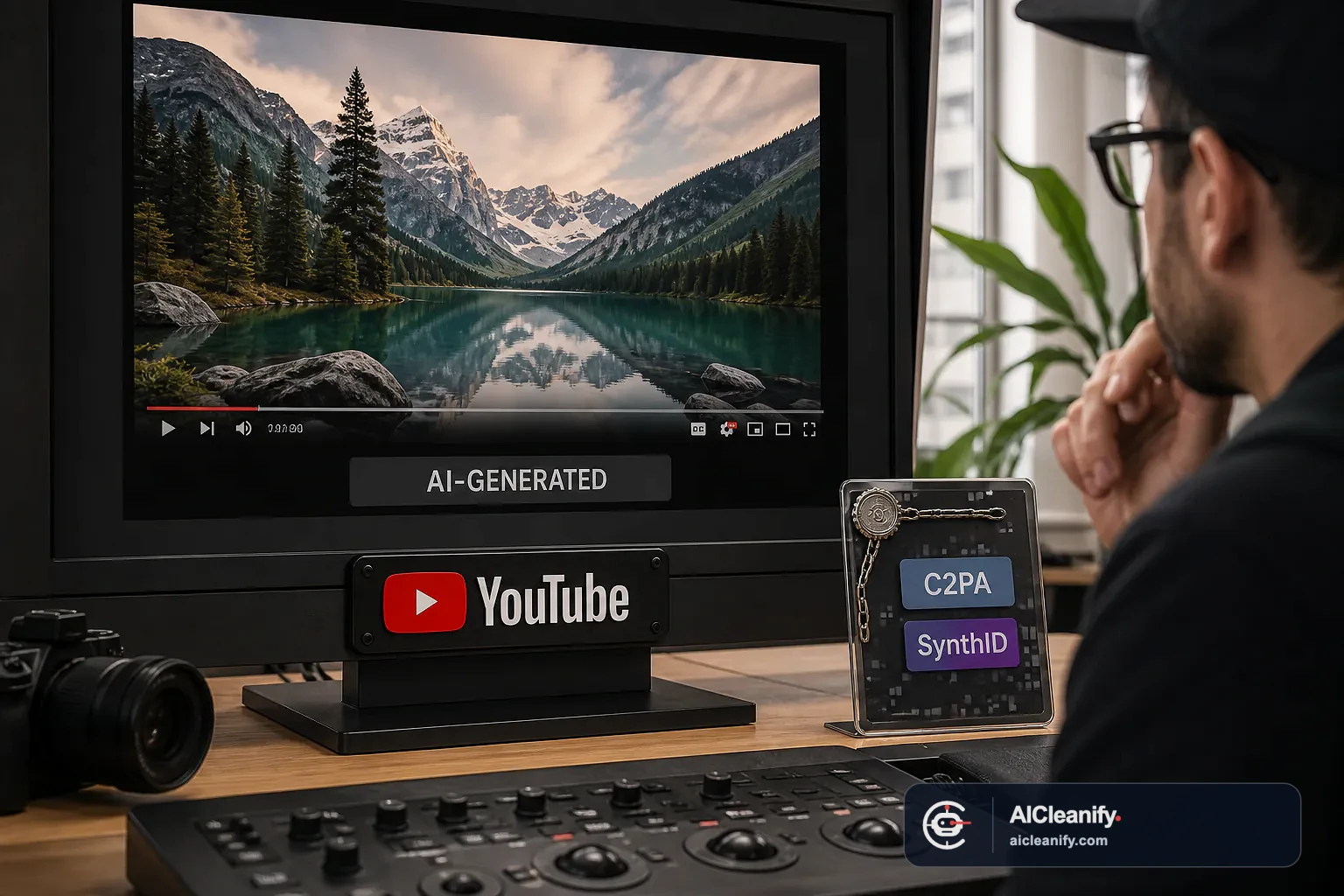
Key takeaways
- As of August 24, 2026, YouTube requires disclosure when AI meaningfully alters or generates content that appears photorealistic, including realistic depictions of people, places, or events.
- A creator can correct most automatically detected labels in Studio, but labels tied to YouTube AI tools, qualifying C2PA evidence, or Trust and Safety review cannot be adjusted.
- YouTube says an AI disclosure label alone does not change recommendations or monetization eligibility; originality, authenticity, rights, policy compliance, and viewer response still matter.
- C2PA is a signed provenance framework, SynthID is an imperceptible provider-controlled watermark, and ordinary metadata is editable; they are not interchangeable signals.
- Using AI only for a script, outline, title, thumbnail, captions, upscaling, repair, or another minor production assist generally does not require the altered-content disclosure.
- Creator SEO still depends on accurate packaging, query relevance, engagement, quality, and audience satisfaction—not on trying to hide a required disclosure.
Rules last verified: August 24, 2026. YouTube’s 2026 AI-content update makes disclosure more visible and introduces broader automatic detection, but the basic creator decision remains narrow: disclose when AI meaningfully alters or generates audio or visuals that appear realistic. Do not select “Yes” merely because AI touched a script, outline, title, thumbnail, captions, color grade, repair pass, or other minor production step. The current YouTube disclosure guidance separates realistic, meaningful changes from production assistance and minor edits.
What changed in YouTube’s May 2026 AI label rollout
YouTube has required altered-content disclosure for realistic synthetic media since 2024. The May 27, 2026 YouTube announcement changed how viewers see that information and how the platform can apply it when the creator leaves the survey unanswered.
- One clearer label format: YouTube describes the new format as the single disclosure label for photorealistic content that is meaningfully AI-altered or generated.
- More prominent placement: for long-form videos, the label can sit below the player and above the description; for Shorts, it can appear over the video.
- Expanded automatic detection: when a creator does not specify AI use and YouTube detects significant photorealistic AI, the system may apply the label automatically.
- Creator correction in most cases: YouTube Studio notifies creators about an automatic label. Most detection mistakes can be corrected by changing the AI-use answer to “No.”
- Permanent cases remain: a creator cannot adjust labels grounded in YouTube’s own AI tools, qualifying C2PA evidence, or a manual Trust and Safety decision.
An August 3 update to YouTube’s creator announcement also says automatically labeled videos can be found through the Other notices alert column in Studio’s Content list. Because names and locations in Studio can change, treat this as a dated navigation note rather than a permanent interface promise.
Disclosure decision guide: should you label the video?
Ask about the uploaded result, not every tool used in the production history. The practical test has two parts: is the change meaningful, and does the result look or sound realistic enough to mislead a viewer about what occurred?
| Scenario | Disclosure? | Reason under YouTube’s examples |
|---|---|---|
| A realistic face swap makes a real person appear to endorse a product | Yes | A real person appears to say or do something they did not. |
| A synthetic voice makes a public figure appear to give advice | Yes | The realistic statement or performance did not occur. |
| AI-generated footage shows a tornado approaching a real city | Yes | It is a realistic scene involving a real place and event that did not happen. |
| AI generates realistic extra footage of a real destination for a travel video | Yes | YouTube explicitly lists realistic generated footage of a real place. |
| AI-generated music is used in the finished upload | Yes | YouTube lists AI-generated music among content that needs disclosure. |
| You clone your own voice for a voice-over or dub | Usually no | YouTube currently lists cloning one’s own voice for voice-overs or dubs as an example that does not need disclosure. |
| AI writes an outline, script, title, or thumbnail concept | No, for that alone | These are production-assistance examples, not a meaningful realistic alteration to the uploaded content. |
| Captions, sharpening, upscaling, repair, color correction, or background blur | Usually no | YouTube treats these as minor or assistive edits in its current examples. |
| A clearly animated dragon flies over a fictional city | Usually no | Obviously unrealistic or fantastical content generally does not require the disclosure. |
“Usually” matters because YouTube says its lists are not exhaustive. A familiar editing technique can become meaningful if it changes the apparent facts. Simple color correction is minor; changing a traffic light or removing a person from news footage may alter what viewers believe happened. When the realistic output crosses that line, disclose it.
Exactly how a YouTube AI content label can be applied
Creators often speak about “the YouTube AI watermark” as though one detector controls the result. YouTube’s current documents describe several independent paths to a disclosure:
- Creator disclosure: you select “Yes” under AI use while uploading or editing a video.
- YouTube generative tools: content made with products such as Veo or Dream Screen is disclosed by YouTube’s workflow.
- C2PA Content Credentials: YouTube’s “How this content was made” guidance says it carries forward secure C2PA 2.1-or-higher disclosures that indicate the entire video was made with AI.
- Internal detection: during the 2026 rollout, YouTube may apply a label when its systems detect significant generated or altered content, particularly if the creator did not answer the upload survey.
- Manual review: YouTube may apply a label after Trust and Safety review, including where undisclosed synthetic content could mislead or harm viewers.
A label’s existence does not reveal which classifier, watermark, or review step produced it unless Studio or the “How this content was made” panel provides that context. The panel may include an “Info from” attribution when a C2PA signing authority supplied the disclosure.
When an automatic label can—and cannot—be removed
If an internal automatic detector made a mistake, YouTube says creators can correct the disclosure in most cases. Open the notice in Studio, go to the video or Short’s Attributes section, set the AI-use survey to No, and save. The August 2026 creator update says saving removes the label automatically when the case is eligible for correction.
The non-adjustable cases are narrower and should be recorded precisely:
- YouTube AI tools: labels for content created with YouTube’s internal generative tools, including Veo or Dream Screen, cannot be adjusted by the creator.
- C2PA-triggered labels: YouTube’s May creator announcement describes verified C2PA metadata indicating that the content is fully AI-generated as non-removable. The current Help article uses broader wording—content containing C2PA metadata cannot be adjusted. In practice, do not assume a creator override will be available when C2PA is the basis of YouTube’s label.
- Manual Trust and Safety review: a label applied after manual review cannot be adjusted through the creator survey.
That distinction prevents a common overstatement. An internal machine-detection label is not necessarily permanent, while a platform-tool, qualifying provenance, or manual-review label is. Deleting metadata to avoid disclosure is not a reliable or responsible workflow: the creator’s disclosure duty is based on the content, and YouTube may have other signals.
C2PA, SynthID, and ordinary metadata are different signals
No single “AI watermark” format covers every upload. A reliable review separates signed provenance, imperceptible provider watermarks, editable file fields, and YouTube’s own account-level disclosure.
| Signal | Where it lives | What it can show | Important limitation |
|---|---|---|---|
| C2PA Content Credentials | A signed manifest embedded in or linked to the asset, bound cryptographically to media | Assertions about origin, tools, edits, ingredients, and digital source type; signature validation and signer trust can be evaluated | C2PA is provenance, not a universal truth detector. Embedded manifests can be removed; durable credentials need supported fingerprint or watermark recovery. |
| SynthID | An imperceptible signal embedded in pixels, frames, audio, or generated text by supported Google AI systems | A compatible Google verifier can identify supported content generated or edited by Google AI and may localize affected regions or segments | It is provider-controlled, not ordinary readable metadata, and a negative result does not prove human origin. |
| EXIF, XMP, IPTC, or container metadata | Editable fields stored in the file or media container | Software names, timestamps, export details, and optional AI-related declarations | These fields can be changed or stripped and are not cryptographic attribution on their own. |
| YouTube AI-use survey and internal systems | YouTube’s platform records and detection pipeline | The creator’s declaration, YouTube-tool context, or a platform-applied label | Outsiders cannot reproduce YouTube’s private detector from the uploaded file alone. |
The C2PA explainer describes Content Credentials as tamper-evident, cryptographically signed provenance. It also states that provenance metadata can be removed. Durable Content Credentials address that weakness by using a soft binding—such as a watermark or fingerprint—to recover a remotely stored manifest. This is why “C2PA metadata” and “watermark” sometimes appear together, but they are not synonyms.
Google DeepMind’s SynthID documentation describes a different mechanism. The watermark is embedded into media generated by supported Google products and detected with compatible Google technology. Google says it is designed to withstand common transformations such as cropping, filtering, frame-rate changes, or lossy compression, but also cautions that watermarking is one component of a broader transparency system—not a universal AI detector.
YouTube’s public 2026 label guidance explicitly names its own AI tools, C2PA, internal systems, and manual review as label paths. It does not promise creators that a public SynthID scan maps one-to-one to the YouTube label. A SynthID finding can be useful provider evidence; it should not be presented as a reproduction of YouTube’s private decision. Creators can inspect supported provenance with AICleanify’s C2PA Content Credentials Viewer, review Google-specific signals with the Gemini SynthID Watermark Checker, or run a broader file review in the AI Watermark Checker.
A provenance-safe workflow before upload
The disclosure survey asks a policy question, not a metadata-cleanliness question. Keep a private evidence package even when the published file is compressed: source clips, licenses, model and tool records, consent releases, edit notes, prompts where useful, and the original export containing any Content Credentials. That record helps you answer accurately and resolve later rights, client, or platform questions.
Before the final export, inspect what the file actually carries. Validate a C2PA manifest rather than merely searching for the letters “C2PA.” Note the signer, generator, actions, validation state, and whether the signer is trusted by the verifier. Treat plain generator strings as supporting metadata, not authenticated proof. For Google AI media, use a compatible SynthID verifier when access and format support are available.
Transcoding can change this evidence. The C2PA chain may survive only through software that understands and re-signs the provenance history. A social export, messaging app, or unsupported editor may strip an embedded manifest. Conversely, an imperceptible watermark may survive transformations that remove ordinary metadata. Inspect the exact file you plan to upload, not just the camera original.
Upload checklist for AI-generated or altered video
- Review the finished audio and visuals. Mark every realistic synthetic person, voice, place, event, performance, or scene—not just shots created entirely by AI.
- Apply the meaningful-and-realistic test. Minor aesthetics and production assistance usually do not trigger disclosure; factual-looking synthetic output does.
- Clear rights and permissions. Confirm commercial rights for models, music, voices, stock, footage, fonts, and identifiable likenesses. Disclosure does not create permission.
- Inspect the final export. Check C2PA, ordinary metadata, and any provider verification available for the tools used. Save the report with your production records.
- Answer the AI-use survey. In Studio’s Attributes section, choose Yes when the video meets the requirement; do not rely on YouTube to detect it for you.
- Check the processed upload. After publication, review the player, expanded description, and Studio notices to confirm how YouTube displayed the disclosure.
- Correct genuine mistakes only. If an internal automatic label is wrong, use Studio’s survey correction. Do not contest a truthful label simply because it is prominent.
- Keep a dated policy note. Platform rules and Studio interfaces change. Record the guidance and date used for the publishing decision.
AI video monetization in 2026: disclosure is not the test
YouTube’s statement is exact: applying the AI label alone does not affect a video’s eligibility to earn money. That means the label is not an automatic demonetization flag. It also does not mean every labeled video qualifies for the YouTube Partner Program or for ads.
The YouTube channel monetization policies require content to be original and authentic, not mass-produced, generic, repetitive, or manipulative. The policy’s examples identify AI-generated content made from generic or unoriginal templates that give the impression of mass production without the creator’s authentic insight as ineligible. The rule focuses on the viewer value and production pattern, not a blanket ban on AI tools.
For a monetization review, make the creator contribution visible and substantive: original reporting or research, a distinct argument, expert explanation, meaningful commentary, custom storytelling, deliberate editing, or a genuinely varied series concept. A human voice pasted onto interchangeable generated slides is not made original merely by changing a few nouns. At the same time, a responsibly disclosed animation, documentary reconstruction, or visual explanation can have substantial creative value.
Rights are a separate gate. You need the commercial right to use every audio and visual element. A truthful AI label does not cure an unlicensed song, an unauthorized celebrity voice, a privacy violation, reused footage with minimal transformation, or content that is unsuitable for advertisers. Channel reviewers may examine the main theme, most-viewed and newest videos, watch-time concentration, titles, thumbnails, descriptions, and About section. Evaluate the channel as a body of work, not one upload in isolation.
Creator SEO after the label change
There is no evidence-backed “AI label penalty” to optimize around. YouTube’s 2026 creator announcement says the label alone does not affect recommendations, while its search documentation identifies relevance, engagement, and quality as core ranking elements. Its recommendation guidance frames performance through appeal, engagement, and satisfaction.
Use that distinction to build a practical AI content creator SEO plan:
- Match a real search intent. Put the main subject in the title, description, spoken explanation, and on-screen context naturally. YouTube says query matching considers the title, tags, description, and video content.
- Package accurately. A title and thumbnail should promise the experience the opening delivers. Sensational synthetic imagery that creates the wrong expectation can win a click and lose satisfaction.
- Answer early. State the viewer’s outcome in the opening, then demonstrate it. This supports retention without padded introductions.
- Add evidence and expertise. Cite primary material in the description, explain what is known versus inferred, and date-stamp fast-changing rules. Quality matters especially for news, finance, health, elections, and other sensitive topics.
- Write for viewers before tags. YouTube says tags can help with common misspellings but are not essential for discovery. Clear titles, thumbnails, descriptions, and useful content deserve more attention.
- Measure the right response. Review click-through rate by surface, audience retention at key moments, search terms, returning viewers, and satisfaction proxies. No one metric guarantees distribution.
Transparency can also improve the viewing experience when it answers an obvious question before it becomes a distraction. A short description note can explain which shots or audio were synthetic, which sources were used, and what the creator contributed. Do not stuff disclosure terms into every metadata field or make unsupported claims such as “C2PA-certified true.” A valid credential verifies integrity and attribution of assertions; it does not prove that the depicted event happened.
Common mistakes that create avoidable risk
- Disclosing every AI assist: selecting Yes because a language model suggested a title confuses production help with meaningfully altered realistic media.
- Disclosing too little: a short realistic synthetic segment, generated song, or cloned public voice can still trigger the requirement even when most footage is conventional.
- Calling all metadata a watermark: an editable software tag, a signed C2PA assertion, and an imperceptible SynthID signal have different evidentiary value.
- Assuming “no signal” means “not AI”: credentials can be stripped, a format can be unsupported, and provider watermarks require compatible detectors.
- Trying to remove a truthful label: concealment does not change the disclosure duty and repeated non-disclosure can lead to platform-applied labels or penalties.
- Treating disclosure as permission: the label does not resolve copyright, commercial licensing, likeness, impersonation, privacy, or advertiser-suitability issues.
- Equating AI use with inauthentic content: YouTube allows AI-assisted channels to monetize when they meet its policies; the problem is generic, repetitive, mass-produced output without meaningful creator value.
- Promising rankings or revenue: labels, keywords, watch time, and any single optimization tactic cannot guarantee discovery, YPP approval, or earnings.
A practical publishing record
For each upload, keep a compact record with the video URL, publication date, survey answer, reason for that answer, tools used in the final media, rights documentation, source-file checks, and screenshots of any Studio notice. If the content uses a realistic reconstruction, note which sections are synthetic in the description or credits. This is operational hygiene, not a ranking trick.
If YouTube applies an unexpected label, first determine its source. An ordinary automatic detection may be correctable. A YouTube-tool, C2PA, or manual-review label may not be. Reinspect the upload export, compare it with the archived master, and correct only factual errors. For a separate estimate of whether an image has common generative traits, use the AI Image Detector, but do not substitute a probability score for YouTube’s disclosure rules or provenance evidence.
Primary sources and freshness note
This guide relies on first-party platform and standards documentation available on August 24, 2026. YouTube can change its survey wording, label placement, automatic-detection process, and monetization examples. Recheck the live Help pages before a sensitive or high-value upload.
- YouTube Blog: Improving AI labels for viewers and creators — May 27, 2026 rollout summary.
- TeamYouTube: Updates to AI content disclosure and labels — creator controls, permanent cases, placement, performance statement, and August Studio update.
- YouTube Help: Disclosing use of GenAI content — current requirements, examples, automatic detection, and penalties.
- YouTube Help: Understanding “How this content was made” disclosures — disclosure sources, C2PA 2.1-or-higher handling, and signing attribution.
- YouTube Help: Channel monetization policies — original, authentic, inauthentic, and reused-content rules.
- YouTube Help: How YouTube search works — relevance, engagement, and quality signals.
- YouTube Help: Content performance for recommendations — appeal, engagement, satisfaction, packaging, and metadata.
- C2PA: Content Credentials explainer — signed provenance, hard and soft bindings, removal, and durable recovery.
- Google DeepMind: SynthID — supported modalities, embedding, resilience, and verification.
Frequently asked questions
Does the YouTube AI content label reduce recommendations?
No—not by itself. YouTube’s May 2026 announcement says applying the disclosure label alone does not affect recommendations. Search and discovery continue to evaluate audience signals, relevance, engagement, quality, and long-term satisfaction, while separate policy violations can still limit distribution.
Can an AI-generated YouTube video be monetized in 2026?
It can be eligible, but AI use does not guarantee approval. YouTube says the disclosure label alone does not affect monetization eligibility. The channel still needs original and authentic value, commercial rights, advertiser-friendly content, and compliance with YouTube Partner Program and Community Guidelines.
When can a YouTube AI label not be removed?
YouTube says the disclosure cannot be adjusted when the content was made with YouTube’s own AI tools, when qualifying C2PA data triggers the label, or when Trust and Safety manually reviewed and labeled the content. Most other automated mistakes can be corrected through the AI-use survey in Studio.
Are C2PA and SynthID the same kind of YouTube AI watermark?
No. C2PA Content Credentials are signed provenance records that describe origin and edits. SynthID is an imperceptible watermark embedded in media generated or edited by supported Google AI products. A file may contain either, both, or neither, and ordinary metadata is a separate editable layer.
Must I disclose AI used only for a script, title, or thumbnail?
Generally no. YouTube lists scripts, outlines, titles, thumbnails, captions, idea generation, and similar production assistance among examples that do not require disclosure. Disclose when the uploaded audio or visuals themselves are realistically and meaningfully AI-generated or altered.
Does disclosure protect me from copyright or likeness claims?
No. An altered-content disclosure provides context to viewers; it does not grant commercial rights, permission to imitate a person, or immunity from copyright, privacy, Community Guidelines, or advertiser-friendly content rules. Clear the rights and permissions for every element you publish.